
1. Why Collaboration Theory Matters
IN THIS LESSON
There are many collaboration theories and frameworks— but which ones should I focus on?
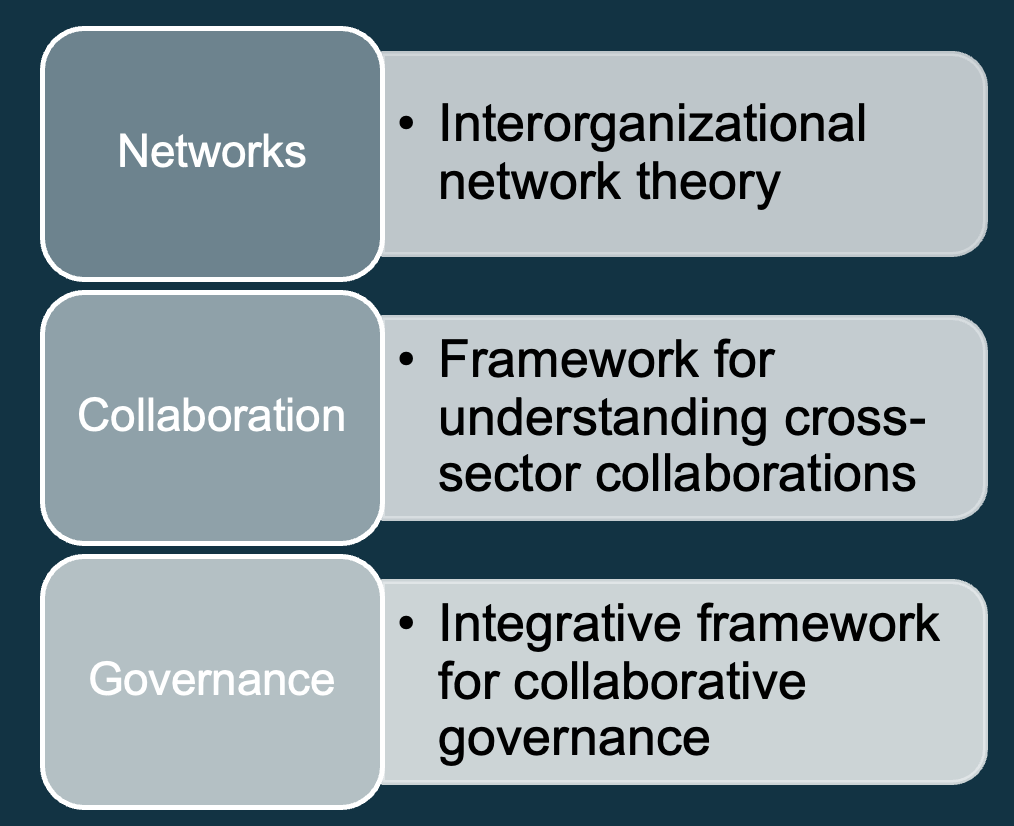
Dozens of collaboration theories and frameworks can help guide our work. We’ll focus on three:
Interorganizational network theory
Framework for understanding cross-sector collaborations
Integrative framework for collaborative governance
These stand out because they are backed by literature and resources, can be applied directly to real-world collaboration, and strike a balance between being simple enough to be used yet complex enough to be useful.
-
-
Collaboration “refers to a 'high intensity' mode of interaction that nurtures mutual interdependence and joint action while preserving the autonomy of collaborating parties.” (1)
Collaborative Partnership refers to “an alliance among people and organizations… working together to achieve a common purpose.” (2)
Theories “describe the mechanisms of change—how we create change and help us understand why certain interventions work or fail. By applying theories, researchers and practitioners can design more effective interventions and tailor them to specific contexts.” (3)
Frameworks “present factors that influence different aspects of implementation and can address complexities beyond the intervention itself. They help us consider context, sustainability, and other critical elements.” (3)
Sources:
Ansell, C., & Gash, A. (2018). Collaborative platforms as a governance strategy. Journal of Public Administration Research and Theory, 28(1), 16–32. https://doi.org/10.1093/jopart/mux030
Roussos, S. T., & Fawcett, S. B. (2000). A Review of Collaborative Partnership as a Strategy for Improving Community Health. Annual Review of Public Health, 21, 369–402.
Department of Global Health. (2025). Putting it into Practice. University of Washington. https://impsciuw.org/implementation-science/explore/impsci-uw/uw-research-category-theories-frameworks/